
Attachment Styles & Their Biblical Responses

Attachment styles explain how the fulfillment (or lack thereof) of a child’s needs can affect a person and their relationships throughout their life. We are wired to connect with others so as infants and children we seek safety, security, and connection from those who care for us. Many of the challenges children face are at the hands of those who are supposed to care about them the most. We learn how to relate, what to expect from them and others, and form a concept of self in relation to secure or insecure attachment styles.
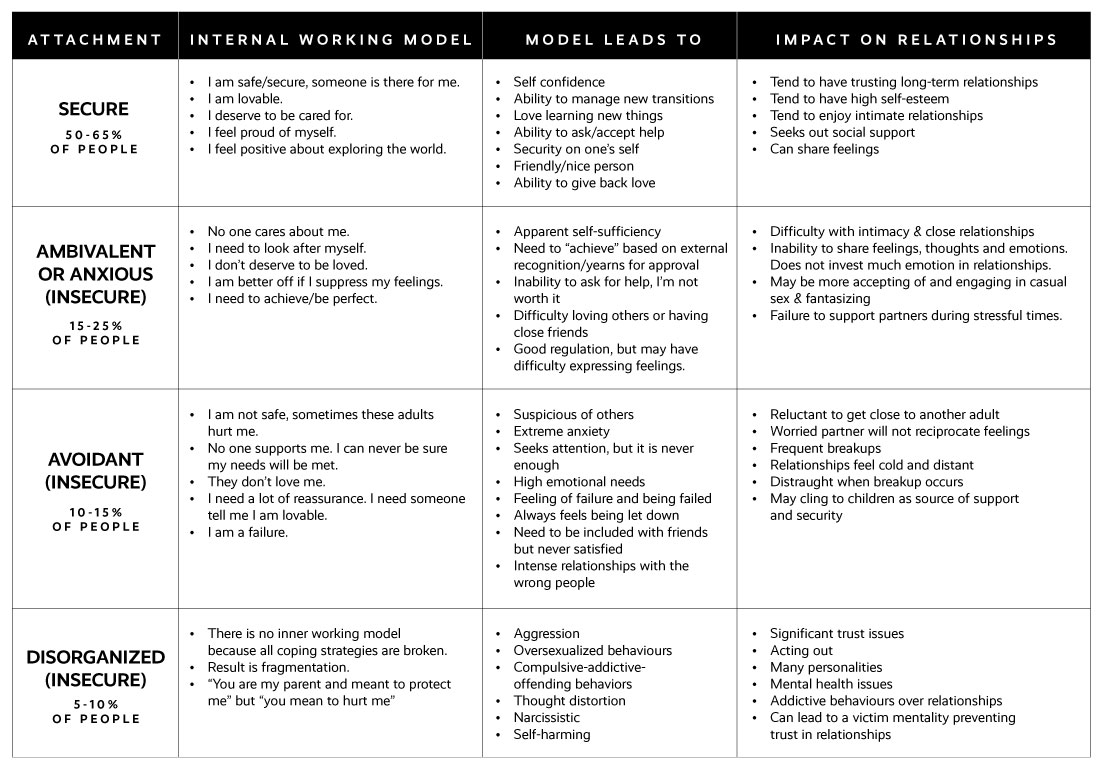
Secure, ambivalent and avoidant attachment are all ORGANIZED attachment styles Ambivalent and avoidant are not totally effective but they at least represent organized coping strategies.
Disorganized attachment is the breakdown of organized coping strategies It is thought to be caused by frightened or frightening parental behavior or trauma or loss of parents.
“A disorganized attachment results when there is no organized strategy that works for the child. Their parents’ behavior is unpredictable which does not allow them to feel safe and get their needs met without fright and terror.” Mary Main
You mean to hurt me. You are my parent(s) and are meant to protect me. These two statements are incompatible with one another. The child’s brain is unable to manage these two incompatible realities resulting in a fragmented response style. Essentially, there is no inner working model to cope because all coping strategies are broken.
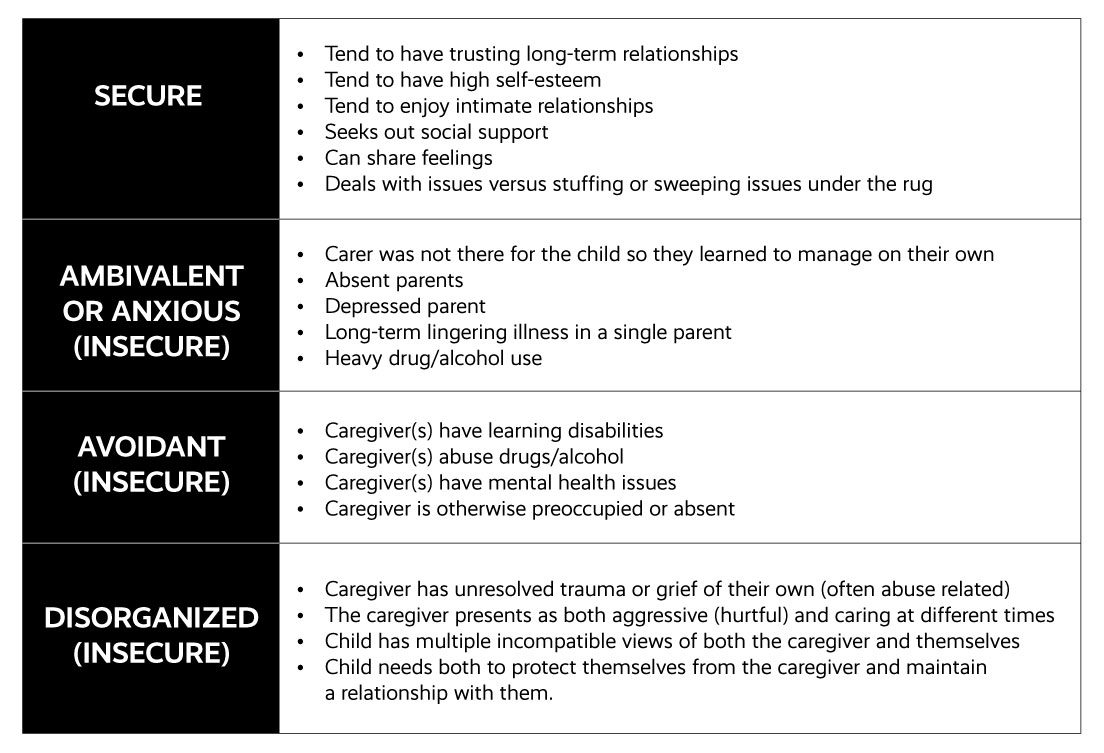
Below is a chart explaining attachment causes based on attributes of the caregiver:
“Wounded Inner Child”
- Unpredictable responses because the brain is fragmented (or dissociated).
- Everything is compartmentalized but various compartments have broken or non-existent links.
- Non sequential behaviors (e.g. affection followed by aggression).
Biblical Response - God created us for affirmation and love, belonging and connection, and meaning and purpose. It is God who affirms and loves us, who gives us belonging and connection, and who provides us with meaning and purpose.
- God affirms us. (Created in God’s image)
- God loves us. (God so loved….)
- God provides a way for us to be in relationship/connected to Him. (Reconciled to God)
- We belong to the family of God. (brothers/sisters in Christ, God places lonely in families)
- God gives us meaning and purpose - to honor Him with our lives. (Live for Christ)
- We were created purpose - to distinctly and uniquely use our gifts and talents for good. (Ephesians 2:10 created for good works.)
Practically a person with attachment problems need:
- To believe they have value.
- A sense of their own identity.
- To understand learning matters. (Growing and maturing)
- To believe the future can be bright. (Hope)
- To believe that they can change. Beliefs cause behavior. Ephesians 4:22-24, Romans 12:1-2 (Renew the Mind)
- To believe that God can forgive and turn their life around.
- To hear from others who believe in them.
Others can help people grow towards a more secure attachment by:
- Giving compliments - prioritize character, be specific and clear, provide evidence.
- Providing an atmosphere of trust.
- Making sure they are seen.
- Seeing the potential that God has for them.
- Encouraging them.
- Creating a sense of security.
- Recognizing people are created for relationships. Build ways for connection/belonging.
- Beginning to give them small amounts of responsibility.
- Praising their efforts.
- Cultivating grace for the other person.
- Asking questions - teenagers need to ask and be asked questions
Truths:
- God is compassionate and wants to comfort all of us.
- God is the source of all healing.
- God will reward faith.
Resilience:
- People have the ability to grow and bounce back.
- Resilience is a mindset (obstacles become opportunities), a recovery process, and a learned ability. It is rooted in relationships and connection with others.
Convictions
- Shape how we should respond.
- We believe in the importance of growing together in community.
- We expect people to become more faithful, more fruitful and more joyful.
Conviction #1 We believe that the gospel changes people.
2 Corinthians 5:17 Therefore if anyone is in Christ, the new creation has come: The old has gone..
- From Dead to Alive - Ephesians 2:4-5 But because of his great love for us, God, who is rich in mercy, made us alive with Christ even when we were dead in transgressions—it is by grace you have been saved.
- From Selfishness to Serving - Galatians 5:13,24 13 You, my brothers and sisters, were called to be free. But do not use your freedom to indulge the flesh; rather, serve one another humbly in love. 24 Those who belong to Christ Jesus have crucified the flesh with its passions and desires.
- From enemies to adopted - Ephesians 1:4-6 For he chose us in him before the creation of the world to be holy and blameless in his sight. In love he predestined us for adoption to sonship through Jesus Christ, in accordance with his pleasure and will— to the praise of his glorious grace, which he has freely given us in the One he loves.
- From being critical to being grace-filled. Romans 12:3 For by the grace given me I say to every one of you: Do not think of yourself more highly than you ought, but rather think of yourself with sober judgment,
- From being judgmental to being merciful. James 3:17 But the wisdom that comes from heaven is first of all pure; then peace-loving, considerate, submissive, full of mercy and good fruit, impartial and sincere.
- Matthew 7:1 “Do not judge, or you too will be judged. For in the same way you judge others, you will be judged, and with the measure you use, it will be measured to you.
- From being led by the flesh to being led by the Spirit, exhibiting the fruit of the Spirit - Galatians 5:22-25 But the fruit of the Spirit is love, joy, peace, forbearance, kindness, goodness, faithfulness, gentleness and self-control. Against such things there is no law. Those who belong to Christ Jesus have crucified the flesh with its passions and desires. Since we live by the Spirit, let us keep in step with the Spirit.
- From idle or coarse speech to life giving speech. - 1 Peter 4:11 If anyone speaks, they should do so as one who speaks the very words of God. If anyone serves, they should do so with the strength God provides, so that in all things God may be praised through Jesus Christ. To him be the glory and the power for ever and ever. Amen.
- 1 Peter 3:10 For, “Whoever would love life and see good days must keep their tongue from evil and their lips from deceitful speech.
Conviction #2 We believe that the scriptures transform people.
- Romans 12:2 Do not conform to the pattern of this world, but be transformed by the renewing of your mind. Then you will be able to test and approve what God’s will is—his good, pleasing and perfect will.
- 2 Timothy 3:16-17 All Scripture is God-breathed and is useful for teaching, rebuking, correcting and training in righteousness, so that the servant of God may be thoroughly equipped for every good work.
Conviction #3 We believe sin damages but cannot defeat us.
- James 1:13-15 When tempted, no one should say, “God is tempting me.” For God can’t be tempted by evil, nor does he tempt anyone; but each person is tempted when they are dragged away by their own evil desire….
- 1 John 1:9 If we confess our sins, he is faithful and just and will forgive us our sins and purify us from all unrighteousness.
Conviction #4 We believe that God redeems suffering for good.
- Romans 5:3-5 Not only so, but we also glory in our sufferings, because we know that suffering produces perseverance; perseverance, character; and character, hope. And hope does not put us to shame, because God’s love has been poured out into our hearts through the Holy Spirit, who has been given to us.
- James 1:2-4 Consider it pure joy, my brothers and sisters, whenever you face trials of many kinds, because you know that the testing of your faith produces perseverance.
Conviction #5 We believe change takes place progressively over time.
- 2 Peter 1:5-9 NKJV But also for this very reason, giving all diligence, add to your faith virtue, to virtue knowledge, to knowledge self-control, to self-control perseverance, to perseverance godliness, to godliness brotherly kindness and to brotherly kindness love. For if these things are yours and abound, you will be neither barren nor unfruitful in the knowledge of our Lord Jesus Christ.
The sanctification process requires:
- FAITH - the starting point.
- VIRTUE - a desire to please God.
- KNOWLEDGE - learning God’s way to live.
- SELF-CONTROL - disciplined to live according to God’s Word.
- PERSEVERANCE - continue until there’s a change in heart, mind and actions.
The results of the sanctification process:
- GODLINESS - faithfulness over time.
- BROTHERLY KINDNESS - acting towards others as Christ would.
- LOVE - serving God and serving others.

Download Our App
Explore your faith and build daily habits using our app.


You also might like

How to walk with someone struggling with mental health

Navigating Mental Health: First Steps & Resources

Defense Against the Dark: Breaking Free from Spiritual Bondage

Serve Our Community

Shining Light in Our Neighborhoods: Living Out Matthew 5 in Community

I’m struggling with mental health, does God still love me?

When Bad Things Happen

What Does God’s Word Say About Mental Health

What Could God Be Up To Right Now?
.jpeg)
What A Week (Again…)

Pressure Can Teach Us To Love

Hope For The Sake Of Others

Practicing Journaling

Silence and Solitude
